Showing posts with label Kiryat Malachi. Show all posts

Thursday, July 08, 2010

First Full week in Israel, July 2010

Today marks a full week that we have been in Israel and both of us have fully adjusted.  Howard had not been here for 2 years, so he was excited to be back, and he is getting more involved more quickly....napping a bit less as we also have an extra room with air conditioning!

After a lovely restful Shabbat in Shuval with our friends Haim and Shunamit, we visited friends in Kibbutz Beit Kama Saturday night.  Our friend recently moved back to the kibbutz where he grew up.  His father is still very much of a kibbutznik, working in agriculture.  He used to work in cotton, but it is no longer grown beause of the amount of water needed.   The mother teaches at a university in Beersheva and is also a midwife.  Their other child also recently moved back to the kibbutz.  I'm envious. It iswonderful to have grandparents and siblings with their young children so close by. 

Beit Kama is also going through a kind of privatization.  The dining room is only open during the day, but because of requests, it will now be open one Friday night a month for a community Shabbat dinner.  Most of the businesses have been outsourced or are done in partnership with another kibbutz.  There are two new building areas for homes.  One is for returning "children" of members like our friends.  They are hoping to keep the same "feeling" of the kibbutz with homes that are not too big and nature surrounding them. The other  new building area is for people from "outside." Their homes are definitely bigger...  Howard and I like our friends prefer the older format!


This picture above is of very tall Yucca plants along the side of one of the older houses.  They must help keep the home cool in summer.This picture  belowshows how a new leaf is added to this fiscus tree.  It starts as a red casing which gets bigger, splits open, and then becomes a leaf.
We’ve kept busy since we arrived in Kiryat Malachi on Sunday.  Aside from Howard’s knee, we are feeling pretty good (as long as I take a Benedryl before going to bed).

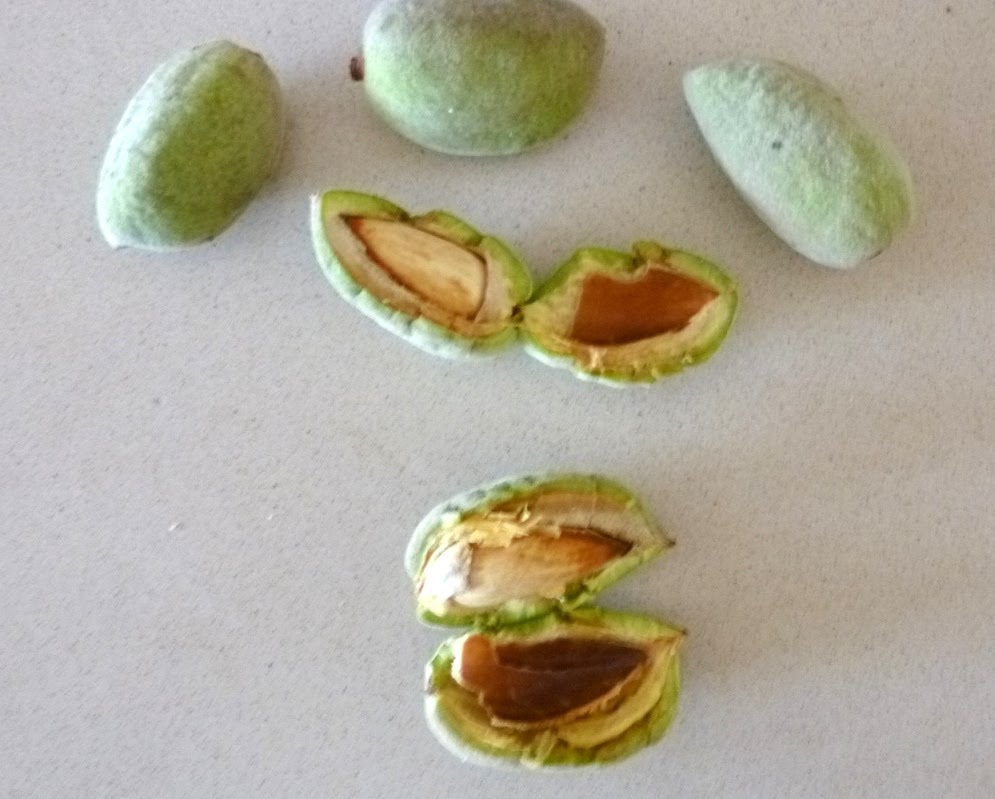
We’ve been to two supermarkets and to the local shuk, which is just across the street. (I am always surprised at how expensive food is here in supermarkets.) The shuk (market) is open on Mondays and Thursdays, and on Thursday (today), it is mainly a food market—fruits, vegetables, and nuts. I came home today with my arms loaded with a watermelon, an Israeli melon (not as orange as a cantaloupe), a ½ kilo of fresh figs, tiny pears and small peaches, etc. I’m going to go back for fresh almonds in their original (green) casing and maybe some more fresh lychee.   You can see below the almonds I bought when I did go back.  The green shell is the actual shell of the almond.  What we know as the brown shell is actually soft at first and then starts to harden.  The taste is similar to that of almond flavoring...different from dried almonds.  (BTW, when I went back at 6 p.m., some of the produce venders had lowered their prices substantially....a good time to shop for bargans.  For examples, cucumbers were down from 1.5 shekels a kilo to 1 shekel per kilo (i.e. 28 cents for 2.2 pounds).

Howard has been busy this week and has gotten involved in 3 different places.

First of all on Sunday we together when to a program called Tzeva. It is an enrichment and homework after-school program during the school year to help some lower income children. Several national service young women volunteer there during the year. (They are Orthodox teens, recent high school graduates, who do this service instead of the army.) 2 days a week third and fourth graders attend, and another 2 days 5th and 6th graders attend. This summer, they have a three-week program, but just 2 days a week, Sunday and Monday. The coordinator, Merav, is great. She works very well with the children. Unfortunately, she doesn’t have enough volunteers to run it more days.

On Sunday, when we first went, there were 3 young women from national service came, plus another woman named Hadar who I later found out was Dvora’s daughter-in-law. She first got involved with Tzeva through a college community service class she took at Achva college, a program that our TIPS partnership once sponsored. She liked Tzeva so much that she continues to volunteer some. The next day, however, Howard was the only volunteer.  The program has a set of "golden rules:"

Don't abuse others; be respectful; come on time.

One ten-year-old boy named Ben latched on to Howard right away. Ben’s mother is French, and Ben speaks French and some English with her too, so he was excited to talk English with Howard, and his English was good extremely good for someone his age.

Howard also played hopscotch with the kids during a recess.  The next day, a petite Ethiopian girl, also the same age, came just because she knew Howard was there. Her English was good too—mainly from watching TV programs in English.

Howard painted with Q-tips with the kids while I did word searches in Hebrew on the topic of summer with others. Later, during large group activities, we learned the game “Yahm-Yavesha.” It is like a very simple Simon Says. There is a line in the room. One side is “yahm” (ocean) and the other is “yavesha” –dry land. When the leader shouts one of the words, each participant has to jump to the correct side.


We then played a bit of non-competitive volleyball as well as other games. One boy, David, was acting out destructively so he was sent to another alcove. Howard went over to him and calmed him down with a bit of attention—they compared watches.

Howard also helped an 11th grade girl named Sara prepare for the top level (5 pt) repeat Bagrut exam in English (like the SAT subject exams). She is in the alternative school program (Beit Novea)—less formal than in the US. She’s also Ethiopian and has learned a lot of English from TV too. Last year, when she started at Beit Novea, they didn’t know what test for her to try. She took the 3 pt exam and scored 100%. She’s quite sharp so I’m glad that she found her way back to a school program.  (This is a program that Shalom Eldar from our TIPS steering committee helps administrate.)

Atidim is a special program program to help disadvantaged youth prepare to become army officers. It starts with youth as young as 7th graders and teaches them many good life skills. The director for the local program in town wanted to run an English class for outgoing 7th graders, and because Howard was here, she could start it. Yesterday (Wednesday) was the first day. Howard had about 7 or 8 girls and one boy. The girls in skirts were from the religious public secondary school AMIT, and the others were from AMAL, the non-religious public school. He really is a born teacher, and it showed here from what he told me. He got the kids to talk a bit about their interests. He found out that they liked romantic movies. So he told them about the most romantic movie he has ever seen, “Casablanca.” He told them the story, briefly, but did not tell him which of the 2 men that the main star chose. (The teacher may get the movie so that he can show it to them and use it as a teaching tool.)

Howard also found out that they wanted to do vocabulary work, so they reviewed everything they could see in the room. New words that he taught included “elbow.” Then in the afternoon, we went to the library and took out 4 picture dictionaries that he could use with vocabulary by topic. I am so well known at the town library that they let us take the books, though the usual limit is just 2 books at a time.


He said that some liked to talk and others liked to listen, and he was happy to let them do either. They don’t want to do “activity book” work, and neither does he!

Last night Howard downloaded a bunch of pictures to his new IPad to take to class today, and the girls enjoyed seeing them. Three new people showed up today but the one boy was missing.

It says a lot if so many show up the second day….during summer vacation to a non-required class. He will continue next week from 10 a.m. to noon, but with 2 smaller groups, the AMIT group first and then the AMAL group. The AMIT girls want to practice writing, and came prepared today with notebooks and pencils. I’ll be happy to help him with writing starting on Sunday.

Last Monday, we went over to the new open mall just across the highway from town (about 4 blocks from us). In the side area of the parking lot, adjacent to MacDonalds and Cafe' Joe, there was Israeli dancing in the parking lot.

Ira (on the left in the 2nd photo) stayed for several hours, and I also ran into Esti, the science center administrative assistant. Esti invited us to go with her on Wednesday to participate in the walk with Gilad Shalit’s family to Jerusalem. It started at their home in the Galil (Galilee) and by Wed. would be at Latrun. I knew I had to work with Ira on the TIPS calendar, and also was concerned about being outside in the heat of the day. Today, she told me it was a fantastic experience. They waited for 2 hours in the open sun, but then walked with the family for an hour. If you haven’t heard of the walk, it is major news here, taking over a week total. The idea is to get enough attention to at least improve the conditions for Shalit and for some communication to exist and health visits.

Howard also found out that lattes at MacDonalds at the mall were just as good as those at Cuppa Joe or Aroma and a lot cheaper!  Howard picked out some Israeli style t-shirts (4 for 100 shekels, or about $7 each) at Tabun in the mall....

The TIPS Partnership (Tucson Israel Phoenix Seattle) that I’m co-chair of has had an annual art contest for 5th and 6th graders. This year the theme was partnership and the top entries from the 5 communities (Israel = Kiryat Malachi and Hof Ashkelon) are on display at the entrance to the town libraries. I’ve been helping to put together the format for the calendar that will be made for Israel this year. (The American communities have asked for note cards, something not used here in Israel as we do in the US.) I’ve been typing in Hebrew, and have gotten the basics down for touch-typing in Hebrew. I’m astounded!

News this week has included the following:
1)  World Soccer cup   (Yay Spain!  The final should be fascinating though I still find it hard to believe that Brazil and Argetina dropped out so early.)
2)  Traffic accidents--especially hit and runs....there have been more than 250 hit and runs so far this year leaving someone with serious injuries or killing the person hit
3)  The march of Gilad Shalit's family to Jerusalem (mentioned earlier) (In the 12 days of the march, which ended today, a total of 110,000 people marched with the family.)
4)  Netanyahu's visit to Washington

I'm working to see lots of people.  Life here is always hectic, with schedules filled from morning to night, so we are working on scheduling.  As one of our reps said, when living in Canada as a "shaliach" (Israel cultural rep) they had plenty of time to drink coffee but not a lot of friends to drink it with, but in Israel they have very very little time to drink coffee (i.e. free time) and many many people to drink with.  Israelis are very open, and one can drop by without an invitation, but there is less and less time to do so.)

Our plans for Shabbat are in place and schedule next week is filling up. We are going to visit our friend Dalia in Menachemia , just south of the Kinneret, stoping at Neot Kedumim, the Biblical Landscape Reserve, on the way. We’ve never been there and it sounds fascinating. Check it out at :
http://www.n-k.org.il/public/english/index.htm


Shabbat Shalom,

Dina and Howard


Sunday, August 17, 2008

Israeli Teens Volunteering in Seattle, Summer 2008

Although this blog is about my traveling in Israel, I'm going to write about five Israelis who traveled from Kiryat Malachi and Hof Ashkelon this summer to volunteer at Jewish day camps in the Seattle area for 6 weeks, through the TIPS partnership, a program that the Jewish Federation of Greater Seattle participates in. This is at least the fifth consecutive year that teens from there have come to Seattle to add a bit of Israel to local camps. Usually youth ages 17 and 18 come, but because of the teachers' strike in Israel this year, matriculation exams were pushed back to mid July and the older youth could not come, so four 16-year-olds came. They were young but extremely enthusiastic, and with advance planning in Seattle and Israel, they have been able to add a lot more about Israel than in the past, and the camp directors have been thrilled.

Mor, Or, Livnat, Yuval, and Tal

Mor and Livnat are from Kiryat Malachi. Yuval, Or, and Tal live in Hof Ashkelon. Yuval lives on Kibbutz Zikim. I've already written about our visit to his kibbutz. Or lives on Moshav Kohav Michael, a flourishing community about 5 miles north of Sderot, with many members who immigrated from Argentina in the 1960s. Tal is the chaperone, a university graduate from Moshav Gea. The four sixteen-year-olds were picked from about three-dozen that applied, and we have been delighted to have them in town.

The five have been housed in the area with a total of eleven host families during their six weeks here. Two spent three days at the new camp run by the Jewish Day School of Metropolitan Seattle and Temple B'nai Torah. The last day, they ran a three-hour pre-army "Gadna" session, which was the highlight of the campers' week. They five have mainly been at the Strom JCC, with youth from ages 6 to 12, Monday through Friday from 9 to 4. In addition to helping a counselor with a group of campers, for the first time, they led "hugim" Monday through Thursday on Israeli and Jewish topics from 1 to 2 p.m. Each day for a week, they present the same topic to a different group of youth. Topics they have covered include holidays, Jewish and Israeli symbols, food, and Israeli children songs and games. (See a separate entry about the hugim.)

At the end of the first three-week session, they created and directed IsraeLand at the JCC on Friday afternoon from 1 to 3:15 pm. It was a huge success. 250 youth at the JCC day camp from ages 6 to 13 learned about Israel in a very festive atmosphere as they rotated through eleven stations depicting different geographic parts of Israel and different activities. To begin with, they all saw a short multi-media presentation on Israel. Then they all went outside on the lawn to start their Israel experience.

In Jerusalem, they learned about the importance of the kotel, wrote their own notes and put them in the "wall." All the notes will be taken to Jerusalem when the Israeli counselors return to Israel the end of August.


At the kibbutz, the campers learned how to milk cows by hand. That booth was run by Yuval who lives on Kibbutz Zikim, which has a successful dairy herd. He told the youth that he has milked cows, but only using machines.


At Geva, the kids learned Israeli dancing and improv in the middle of the dance circle.


Gadna (Pre-army training) was rigorous and a favorite of many of the campers.

Campers answered trivia questions at the Haifa booth and were rewarded with candy for correct answers.


In Teveria, youth learned the importance of saving water. Then they ran with wet sponges from one bucket to another, trying not to drop any water on the way.


In the Negev, they stopped at the Dead Sea and heard the Biblical story of Sodom and Gemorrah, where Lot's wife turned into salt. Then they made salt pictures to take home.


In Eilat, they went fishing for prizes (stars of David) in the Red Sea (actually the pool). This station turned out to be trickier than the planners had thought.


In Netanya, youth took park in Maccabi Games. Quick reflexes and quick thinking were the keep to this station.


Under a Beduin tent, campers listened to stories that Beduin children also hear.


Finally, in Tel Aviv, they went to a typical Israeli restaurant, where they ate pita with hummus and Israeli salad.


When one 4th grader was asked what his favorite part of the day was, he said that it was a tie between the Gadna training and the Beduin stories.

Although there was competition from the Blue Angels as they flew overhead, the campers stayed focused.


As the day wound down, all 250 campers went back to the auditorium to hear a story about Shabbat by Rabbi James Mirel of Temple B'nai Torah.

A brief staff meeting following the clean up. Zach Duitch, the camp director told all how great the afternoon had been and appreciated the participation of all, especially the 5 planners.

In addition to all their hard work, they have had fun and seen a bit of the area. Four Jewish teens from Hungary are also at the JCC this summer, and the 8 youths have become friends. Places they have visited include Mt Rainier, Snoqualmie Falls, and the historic Pike Place Market. They four also went on a personal tour of Microsoft, visited the Museum of Flight, and two went on a tour of the Boeing Airplane plant in Everett. They rode on a ferry in Puget Sound, attended an annual Japanese festival, swam in pools and Lake Washington, and, of course, shopped! And best of all, they have shared a lot of themselves and made friends that will last a lifetime.

Tuesday, August 05, 2008

Balaynesh Moll Ayeh

Beth Mitchel, from the Seattle area, was one of the four counselors who came to Kiryat Malachi this summer to work at an English-focused camp. The counseling program was a People-to-People project of the TIPS Partnership. The Jewish Federation of Greater Seattle helps support this program as well as a TIPS program that brings Israeli teens to Seattle to work as counselors at local camps.

As part of the program, all four counselors stayed with families in Kiryat Malachi. Beth was hosted by Balaynesh Moll Ayeh and her youngest daughter, 19-year-old Einav, Beth’s roommate.

I had met Balaynesh previously, so she was happy to have me visit her home and talk with her about the hosting experience. After talking a bit, I asked if she wouldn’t mind telling me how she came to be in Kiryat Malachi, and she readily agreed.

Balaynesh was raised in Addis Ababa. She married after high school, and her husband thought it was very important for her to get her driver’s license and a university decree, so she got a BA in Business. After graduation, she worked in a bank in Addis, and used English a lot.

Balaynesh and her husband have 5 children, 2 sons and 3 daughters, from the ages of 19 to 31. In 1986, they sent their two oldest children, ages 7 and 8, to Israel, where they lived in a boarding school, in Kiryat Gat. Three years later her parents made aliyah and eventually moved to Kiryat Gat. In 1991, after not having seen her son and daughter for five years, she took her youngest child Einav (age 2) to Israel to visit them.

The children had missed the family terribly. They said that if their mother didn’t stay with them in Israel, they would insist on going back to Ethiopia with her. So Balaynesh called her husband and told him she had no choice. She went back to Ethiopia to get the other two children.

For the time being, her husband stayed in Addis to continue working there. They were giving up a lot of creature comforts to move to Israel, for they lived in a large 13-room home with large garden, but it was very important for them to live in Israel.

The family of 6 moved into an absorption center in Kiryat Gat. They had a very tiny apartment, but the children were all together again. Children #3 and #4 had trouble adjusting to school, so Balaynesh cleaned a woman’s huge 3-story home, and in exchange that woman tutored the two children. After a few months the two were so much better that they began to help others in their class.


Many Ethiopians have had to stay in absorption centers for more than 3 years before they move to their own apartment, but Balaynesh knew it was critical to move her children into a place they could call home. Balaynesh approached a wonderful man named Elias from the Jewish Agency. He understood her need, and took her on a tour of the surrounding areas. When they approached Kiryat Malachi, she felt like this was the place they should live. After a few weeks, Elias called and told her he had found the perfect apartment for her, and if she didn’t grab it, she would never find one so good. The apartment was great—with 3 big bedrooms, a huge kitchen, 2 bathrooms, and a living room. When she discussed details, her oldest son took notes. The apartment also had almost new furniture throughout. She was delighted with the find, and the family still lives there. It is about a block north of Bar Yehuda, with a nice grassy strip with benches dividing the lanes in the street in front of her building. Balaynesh says that their home has been open like “Avraham Avinu’s” with people always welcome. (As a result, Beth was able to meet a lot of local people.)


Four years later, her husband came to Israel. He also speaks English well. He started an import business but it was not really profitable. Currently he is working in a hotel in Eliot for 6 months.

Baylaynesh held a number of jobs and is proud that her family was never dependent on the social welfare office. In 1994, she worked in Ashdod, and in 1998, she began to work at Kupat Holim, helping new immigrants adjust to the medical system in Israel. Her job is in Kiryat Malachi, so it is closer to home, but there is a lot more pressure. She works in 3 clinics and sees up to 50 clients a day.

Five years ago, she was encouraged to run for the 13-member city council. She agreed to run because she felt that if she worked inside the system, she would help immigrants more. She was elected to the council with the second highest number of votes, even without campaigning. 2003 was the first year that Ethiopian Israelis won seats on city councils throughout the country. Currently there are six or seven such members throughout the country including two in Kiryat Malachi, one in Yavneh, Kvar Saba and Rehovot. She is the only woman in such a position. She is on the city tax committee and has helped to amend mortgage rules there. The other member in Kiryat Malachi is Solomon Yihi. Baylaynesh plans to run again in the city elections this November as she feels she can accomplish more now that she has adapted to the system.

Balaynesh’s five children have done very well. The oldest is a CPA with an MBA and a degree in computers. Another is a photographer; another has a degree in Logistics, and the 4th is studying to be a teacher.


Einav is the youngest. She is doing her national service in town and has worked in Etzion School. Next year she will be in Even Shmuel in Binyamina, helping new immigrants. She is also in charge of the B’nai Akiva groups in town. Three years ago, she started to work with 17 youth at risk through B’nai Akiva, and now eight are either studying or in the army. Three of the children are married, and two are quite religious. Balaynesh is delighted to be a grandmother. . Whenever possible, the family gathers at her home for Shabbat dinner. They continue a family tradition, to discuss what happened during the week and help solve each other’s problems.

Balaynesh invited me to come back whenever I am in town, and I hope to take advantage of her kind invitation.

Tuesday, July 22, 2008

Yizkor (Memorial) Room in Kiryat Malachi, 2008

A special new room has been created in the library building of Kiryat Malachi, a very moving “Yizkor Room. It is dedicated to the memoryt of Israelis from the town who have died before their time, mostly during military service or during a terrorist attack. (For those of you who know the town, it is in the area that formerly was an exercise club. The club has been moved elsewhere.)

Varda, the head of the library, took me on a tour, a few days after we arrived.


After entering on the right one sees awards given to soldiers from town.


The floor has a beautiful map of Israel under glass. The beauty is not diminished even though the map marks where military and terrorist attacks have taken place during the existence of the State of Israel. Unfortunately, I was not able to take a picture of it.

The rest of the walls, have two-deep photos of the local citizens who have died, from right to left in chronological order. You can also see flags of Israel and the military.
As you can see, the lighting is subdued.


The first two men fell during the War of Independence, before Kiryat Malachi (first as Castina) came into existence.
Itamar, above, died in 1948, and Yehezkiel fell in 1950.


1967 awakened me to Israel, so I've included pictures of those who fell in the 6-day war.


I was a member of a kibbutz on the Golan Heights in 1973. Along with the other women and children, my 4-month-old daughter Timna and I were evacuated under fire after dark the first day of the Yom Kippur War, so that war had a huge significance in my life. Here are photos of men who fell in that war from Kiryat Malachi.

Armon S. and Yehezkiel Nissim


Ofir M. and David A. both fell in 2001. Ofir died in a terrorist attack (a pigua). He had graduated from AMIT high school in Kiryat Malachi. His English vocabulary level was so great that his teacher said that he was like an English dictionary. In his memory, donations from the Seattle and Portland Federations 3 years ago helped purchase special, expensive English dictionaries for top students taking the 5 - point English Bagrut exam. (More dictionaries are now needed, BTW.)


Gad Rachamim feel in 2002. He was the brother of Nir Rachamim, the former president of the Kiryat Malachi Youth Council, and a counselor to Palm Springs and Seattle the summer of 2007.

I found the room quite moving. If you get to Kiryat Malachi, this room is a "must" to visit.

Sunday, July 20, 2008

Festival B'Shekel in Kiryat Malachi, July 16, 2008

It's rare for a festival offering major musical acts to take place in an out-of-the-way town. It's even more rare for admission to such festivals to cost just one shekel. But as its name and venue imply, Festival B'Shekel (Festival for a Shekel) does just that.

The festival was founded in 2001 by a group of young community activists in the Jerusalem music scene. Shanan Street, lead vocalist of hip hop group Hadag Nahash, says he's pleased the festival has become a tradition. "I am very proud and excited that the festival has reached the age of five," he says.

Wife of Hadag Nachash leader, together with Itai Z., the regional JAFI coordinator
Festival Coordinator (from the national non-profit)

To provide what it does at such a price, Festival B'Shekel is registered as a non-profit organization. In addition to private donations, its funding comes from various sources, including the Jerusalem Foundation, Pratt Foundation Israel, the Israeli Lottery Council for the Arts, businesses including SanDisk, Omanut Laam, author David Grossman and musician Kobi Oz.

An event organizer heard one local Ethiopian-Israeli girl excited on entrace saying, "I have 11 shekels to spend here today." Usually 11 shekels does not go far, but it got her and a sister, brother or friend into the event and several fruit bars. At the Festival held the day before in the North of Israel, a coordinator was told by a mother of seven that if the event were more than a shekel, she could not afford to come.

Festival B'Shekel's mission goes beyond providing a major, high-quality production for such a minuscule fee. Besides bringing music and culture to places and people that might not otherwise have access to such events, the festival hopes to encourage social and cultural growth across all of Israeli society. To help bring this about, activists head into communities on the periphery months prior to the festival to work with local youth, offering workshops on the array of skills necessary to produce such a huge event.

As in previous years, Festival B'Shekel took place this year in towns on the "periphery" rather than the Tel Aviv and Jerusalem venues where most similar events happen. This year Kiryat Malachi was one of the two towns where it was held. One main reason that the Festival non-profit chose to come to Kiryat Malachi last fall was because of a generous donation by the TIPS Partnership of Partnership 2000 of the Jewish Agency. When the joint American-Israeli steering committee of TIPS decided to focus its core funding on youth and young adults, it turned to the youth in Kiryat Malachi to see what they felt was most needed. There are a lot of talented youth in the arts, especially in dance, singing and bands, and theater. The youth asked for funds to put all of the arts programs for teens under one main program and for funds to help them become more professional.

Art City was organized in Kiryat Malachi as of July 1, 2007, as an umbrella organization to tie together teens in the arts in town, to develop a coordinated and professional group. In its first year it was wildly successful. The $60,000 donation from TIPS helped to bring in professionals to help teach teens to direct and coordinate the music, dance, and theater programs in town. Festival B'shekel also brought in professionals to help in this area with the intent that after this year, the expertise of these people would help Kiryat Malachi youth to continue to develop the arts. Dvora Attal was the city staff member who worked with the TIPS and Festival coordinators.

Dvora and Guy

The youth in Kiryat Malachi are extremely talented. They have just needed the tools to help them succeed, according to Guy and the festival directors.

Members of the TIPS steering committee attended an Art City show on January 31, 2008, and were very impressed by the quality of the acting, singing, and dancing.


We were told that another performance in May was a bit hit in town. An all youth steering committee worked with the town arts director and the Festival to plan the event. Before this year, the 30 members of the steering committee representing music, dance, theater, and stage design had never really gotten to know each other and each other's crafts. One main goal of the Art City project was to bring them together, to get to know each other and each other's talents, something that had not been done before. Guy, the city music coordinator, was also very much involved. Many others were involved including the town youth director and the assistant, Hila.

Park site before the event.

The day before the event, teens were busy making Festival signs. That evening, the city brought in Kobi Peretz for a concert in the part at 7:30. Over 2000 were in attendance. Unfortunately we were visiting a friend an watching the sunset at Ashkelon Beach and did not attend. Peretz is a Mizrachi singer, whose broke into the Israeli music scene in 2003 with his album "Confuse Him."

By 5 p.m., the event was set up in the big park. The entrance gate was behind the matnas, and one shekel (30 cents US) per person was collected for multi-entrance admission.
entrance is to the right of the sign

Tree decoration made from plastic drinking cups!

Early-comers. The park at 5

The other side of the park was also closed off. At that end, there were a number of tables--a few venders and local service representatives.


Sign for girls: "You are not alone"

I bought a very nice wall hanging from a member of a Beduin women's cooperative called "The Center for Bedouin Embroidery, Tatreez Al-Badiah." "The Association for the Improvement of the Status of Women: Laqiya," not too far from Beersheva. For more information, check out the website: www.desert-embroidery.org.


Having fun with Festival adult clowns

Soon, the theater group members were entertaining. Four of five were walking in clown-like costumes on stilts. One, Matan, was a member of Dor Sheni who had visited the US last fall. (BTW, his broken foot had entirely mended.).


One girl was particularly talented and could juggle. The crowd enjoyed her "talking-arguing" with her mom on a juggling pin "phone."

"Musicians" from the acting troup led the stilt walkers around in a parade. A famous comedian entertained a group on a small stage,


and a triple-thick circle of people were entertained by an improv-athletic team.


Youth were selling fruit bars for 2 shekels each, cheap and a delight in the heat!

As you can see, organizers got Festival B'Shekel shirts (in black, blue or red) as did the TIPS visitors including Tucson, and others paid 25 shekels (almost $8) to buy one. (My husband Howard looks great in his!)

Some of the performers were walking around in advance, taking in the scene too:

There were also games for youth to play. Here is Beth, a kefiada counselor from Seattle, trying one.


Shir, Hadar, and Bat-El


The stage beforehand--I was amazed with the amount and quality of the equipment brought in by Festival B'Shekel

Sign in front of stage, close up

One of the famous national singers: Aya Koren:

There was a balance of local performers and nationally famous ones, with the national ones performing a bit more. The local performers held their own and too were wildly applauded. I was so proud of the very professional level of the local artists! This has been a tremendous project for the youth of Kiryat Malachi. (I'm sorry the pictures are so dark, but with thousands of people in the audience and those by the stage dancing in crowded quarters, it was hard to get close to get good shots.


Local singing talent:

Local dancers:


Dance with theme of the 1973 Yom Kippur War

The choreographer is 19, from Kiryat Malachi, and intends to stay here. Because of his unusual talent, the army has stationed him at the local base so that he has time to serve the army and Kiryat Malachi.


After the event, one performer said that to be on the same stage with such nationally known groups was thrilling, a lifelong dream accomplished before he even turned 19! I know that the others must have felt the same!